


The debate about SEO and artificial intelligence It usually starts with a question about the future of Google. David Kaufmann from SEOcrawl AI addressed it with real traffic data. His study, published on October 23, 2026, analyzed aggregated and anonymized data from 16,661 websites using the Google Search Console and 3,949 websites using Google Analytics 4 to measure the traffic of the assistants. The groups with complete histories allow checking whether the trends hold up by comparing the same websites over time. It is a snapshot of sites connected to the platform, and that is the scope with which the figures should be read.
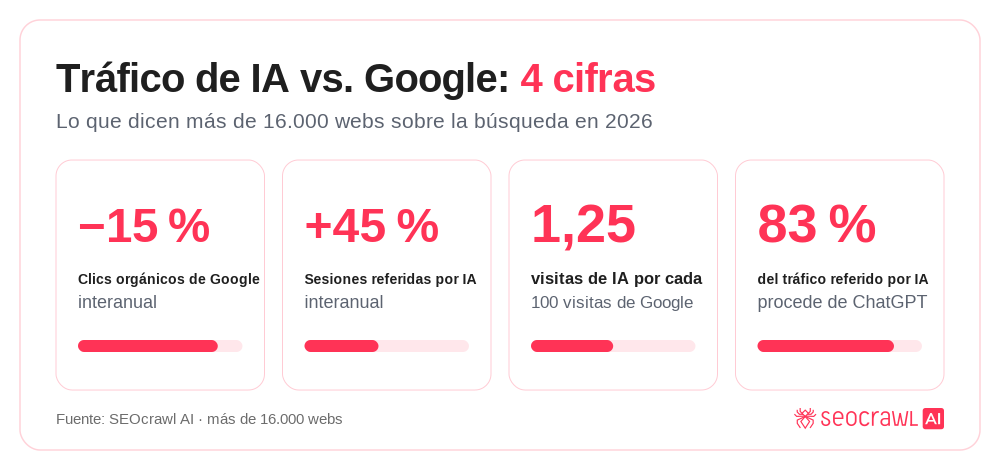
In the twelve months to August 2026, organic Google clicks fell by 15% compared to the previous year. Between March and August, sessions from AI assistants grew by nearly 45% year-on-year. That growth still comes from a small volume: the assistants contributed 1.25 sessions for every 100 organic Google sessions in the study’s comparison.
The data measure identifiable visits, with a limitation that matters when making decisions: a non-clicked mention is excluded from the count, and the clicks from the AI summaries integrated into Google are also not attributed separately to the assistant channel. In Karmina we see a reason to distinguish three things that we usually mix in a report: where the brand appears, how people reach the website, and what they end up doing. A person can learn about a company from a generated response, read a review, and search for their name a few days later. The last click is visible, while the previous steps are more difficult to attribute.
When a customer loses traffic, the first task is to see which queries and pages have lost clicks, whether they have also changed their positions, and how the search result now appears. If the pages that generate opportunities remain, the decision will be different from that of a company that loses visibility in searches closest to the purchase. A drop in visits can only be properly assessed when we know what was lost as a result of those visits.
Part of the content we’ve been publishing for years was driven by a specific incentive: covering more keywords to attract more traffic. With search engines able to summarize a definition or basic explanation directly in the results, it’s worth examining what justifies someone continuing to come to our page. Often it’s information that the company already has and that they’ve only used in meetings, calls, or business presentations until now.
Think of a company that installs air conditioning systems. A general guide on aerothermal systems serves an informational purpose. A comparison based on real installations, explaining in which homes it has worked well, what has influenced the cost and when would recommend another solution, helps to decide. In an e-commerce site, a compatibility table or a video showing the product in use can resolve a doubt that influences the purchase and that a standard product sheet leaves open.
Self-knowledge is an editorial priority. Collecting questions that recur in sales and customer service is one way to find topics, but it’s also a way to spot where the brand makes claims that could be explained better. With this approach, updating a guide or publishing a good case can be more valuable than filling the calendar with new articles.
GEO, or generative engine optimization, incorporates a question into the positioning plan: what do brand assistants say when someone asks about their sector or wants to compare options? To begin answering it, we would conduct periodic tracking of a set of real questions per market and language, noting which brands appear, which sources are cited, and which information is incomplete or incorrect. A single query serves to detect an incident. Repeating it with a consistent approach helps understand whether there is a pattern.
The work that results from this is usually concrete. Checking that the services are explained the same way on the website and in public profiles, publishing a case with verifiable data or improving a page that hides information behind a PDF are actions that also benefit those who arrive through Google. In parallel, reviews, appearances in specialized media and collaborations with industry entities provide external context about what the company does. This places part of the positioning outside the website and makes it necessary for SEO and communication to share priorities.
In the first month, we would establish the measurement base with Search Console, GA4, and the CRM. We would separate brand searches from generic ones, identify the AI referrals that can be measured, and review which pages generate sales, qualified leads, or meetings. We would also choose the questions that are best to be followed up on in the assistives, based on what customers do before making a decision.
Over the following two months, we would work on the pages with the most commercial potential and those where the loss of visibility can be addressed with a concrete improvement. It could be a case of success with testing, a comparison, a clearer service sheet or a form that can be easily completed from mobile devices. At the end of the quarter, we would review what has changed in visibility, which visits have turned into opportunities and what questions continue to come to the sales team. That review is what should tell us where it is worth investing the next euro.
Source of the data and the graph: SEOcrawl AI study, published by David Kaufmann on October 23, 2026.
Written by Arnau Sanz, CEO of Karmina.


